Aug 21, 2025
In Nepal, research explored how repeated climate disasters are linked to changes in women’s safety and daily lives, including increased risk of gender-based violence, but also greater autonomy in decision-making as men migrate for work.
Aug 21, 2025
Enabling civil society organizations (CSOs) in sub-Saharan Africa to develop research ensures equitable scholarly representation and addresses local problems in sexual and reproductive health. To this end, a transnational research collaboration was formed to evaluate abortion services and develop the research capacity of two CSOs in the Democratic Republic of Congo (DRC). The team included Karolinska Institutet, Partners for Reproductive Justice (IPAS) and the National Midwives’ Association (SCOSAF). The objective of this article is to discuss the context of the partnership, including research capacity-building inputs, processes, outputs, and outcomes, as well as lessons learned and recommendations. Activities were tailored to the research capacities of each CSO and the research team of clinical care providers over the two-year project period. Research capacity-building resulted in increased opportunities for team members to conduct research and manage research projects outside of academia. Overall, there were improvements in midwives’ capacity to design and conduct research, and in the midwives’ association’s capacity for research management and project administration. Recommendations for others include pragmatic incorporation of gender considerations, approaches to organizational and individual research capacity-building, and baseline CSO capacity assessments for research management. Health research conducted in a non-academic setting, specifically within CSOs, can be a pathway to research equity. In DRC, it strengthened health professionals in their capacity to generate evidence to influence local abortion policy and health services in Kinshasa, DRC.
Jul 11, 2025
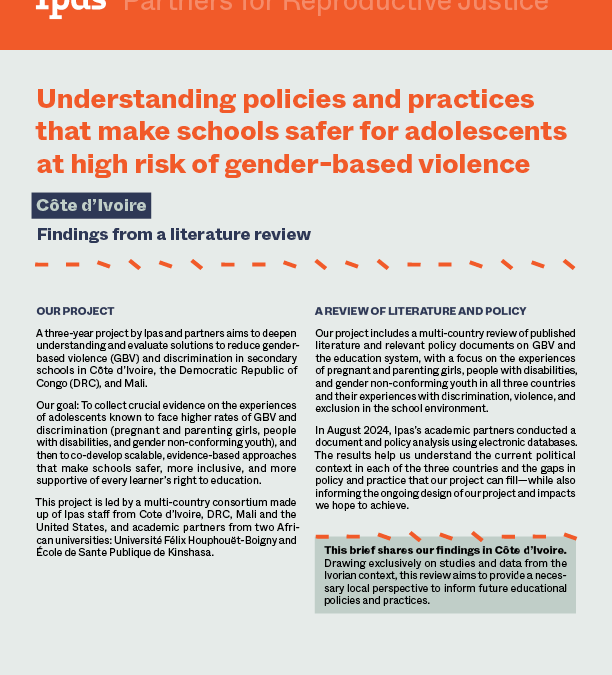
Findings from literature reviews in Côte d’Ivoire, the Democratic Republic of Congo, and Mali
A three-year project by Ipas and partners aims to deepen understanding and evaluate solutions to reduce gender-based violence (GBV) and discrimination in secondary schools in Côte d’Ivoire, the Democratic Republic of Congo (DRC), and Mali.
Jul 10, 2025
For women in Uganda, the experience of seeking and receiving quality abortion care within the public health system can be a challenge due to a restrictive law and abortion stigma. Research shows that high-quality abortion care is client-centered and provided by clinicians that are trained in compassionate communication to improve a client’s experience.
Jun 25, 2025
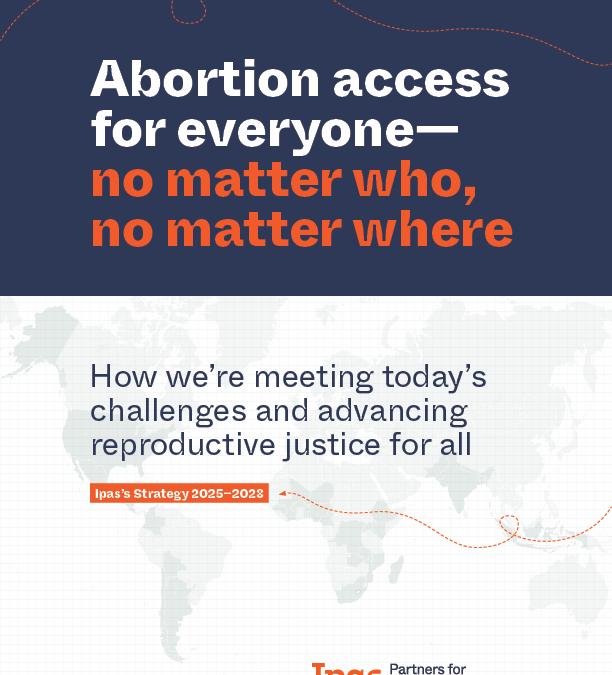
In a world with increasing threats to people’s sexual and reproductive health and rights, Ipas’s work is more vital than ever. We’re no stranger to today’s challenges, and our 50+ years of experience have prepared us well for this critical moment.