



There are few studies in Brazil on the role of the Public Defender’s Office in achieving reproductive justice and, specifically, in guaranteeing the right to abortion. The institutional paths are tortuous for those who request the termination of pregnancy in health services, with several barriers to access to the procedure even within legal parameters. In a scenario of legal restrictions and human rights violations, the Public Defender’s Office acts as a mediator of demands with health services or through requests for judicial authorization from the courts. This article discusses pioneering actions and initiatives by the Public Defender’s Office of the State of Rio de Janeiro in recent years to guarantee legal access to abortion, against threats of regression in law and practice.
Abortion rights in cases of stealthing: reflections, challenges and legal possibilities in Brazil: In 2025, Ipas-supported research in Brazil examined “stealthing,” removing a condom during sex without consent, and how it may fit within Brazilian law as a form of sexual violence with implications for legal abortion eligibility. This paper argues that pregnancies resulting from “stealthing” should qualify for legal abortion under existing exceptions for pregnancies resulting from rape.
An analysis of how the Public Defender’s Office of the State of Rio de Janeiro has contributed, through public advocacy and the use of procedural paths, to overcoming barriers and implementing public health policies to guarantee access to legal abortion.
This two-page fact sheet is adapted from a 2013 Ipas report investigating the impact of criminal abortion laws on women, their families and health-care providers in three South American countries—Bolivia, Brazil and Argentina.
In 2011, the UN Convention on the Elimination of All Forms of Discrimination Against Women (CEDAW) issued a groundbreaking decision in the case of Alyne da Silva Pimentel Teixeira versus Brazil involving the maternal death of a young Afro‐Brazilian woman.
This document gives a summary analysis of primary and secondary data documenting unsafe abortion and the impact of the criminalization of abortion on women’s lives and health and on health services in 5 Brazilian states: Mato Grosso do Sul, Rio de Janeiro, Bahía, Pernambuco, and Paraíba.
La campaña Vai pensando aí de Ipas Brasil cuestiona las opiniones del público sobre la ley del aborto restrictiva en Brasil.
The February 2016 WHO declaration that congenital Zika virus syndrome constitutes a Public Health Emergency of International Concern reacted to the outbreak of the syndrome in Brazil. But the government’s urging to contain the syndrome, which is associated with microcephaly among newborns, is confounded by lack of reproductive health services. Women with low incomes in particular have little access to such health services. The emergency also illuminates the harm of restrictive abortion legislation, and the potential violation of human rights regarding women’s health. Proposed suggestions for remedying the widespread health-care inequities in Brazil are instructive for other countries where congenital Zika virus syndrome is prevalent.
Because Brazilian law only permits abortion in cases of rape, fetal anencephaly, or risk to life, in 2012 the country’s Ministry of Health reported only 1,626 legal abortions in a nation with 203 million people. However, an estimated one million Brazilian women have abortions every year. Many of those women, particularly those without the financial or social resources to see a well-trained, willing provider, run a huge legal risk when they decide to end an unwanted pregnancy. The physical consequences also can be devastating.
This study examined awareness of unwanted pregnancy, abortion behaviour, methods and attitudes toward specific legal indications for abortion via a school-based internet survey among 378 adolescents aged 12–21 years in three Rio de Janeiro public schools.
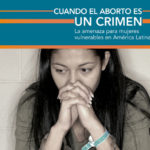
Este informe analiza los hallazgos de una investigación de Ipas de la aplicación de leyes que penalizan el aborto en tres países sudamericanos –Bolivia, Brasil y Argentina— y es el primero en una serie de informes de Ipas sobre el impacto de la penalización del aborto en países alrededor del mundo. Documenta casos de cientos de mujeres y profesionales de la salud que han sido arrestados, acusados, detenidos y a veces encarcelados por violar las leyes referentes al aborto. Hace un llamado a los gobiernos con leyes restrictivas de aborto a que eliminen el aborto de los códigos penales y lo traten como cualquier otro servicio de salud.
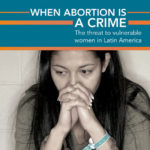
This report analyzes the findings of an Ipas investigation into the enforcement of laws criminalizing abortion in three South American countries—Bolivia, Brazil and Argentina—and is the first in a series of Ipas reports on criminal abortion laws in countries around the world. It documents accounts of hundreds of women and health-care providers who have been arrested, charged, detained and sometimes imprisoned for violating abortion-related laws. It calls on governments with restrictive abortion laws to remove abortion from criminal or penal codes and treat it as any other health-care service.