


Sara Jin Li
What doesn’t kill you
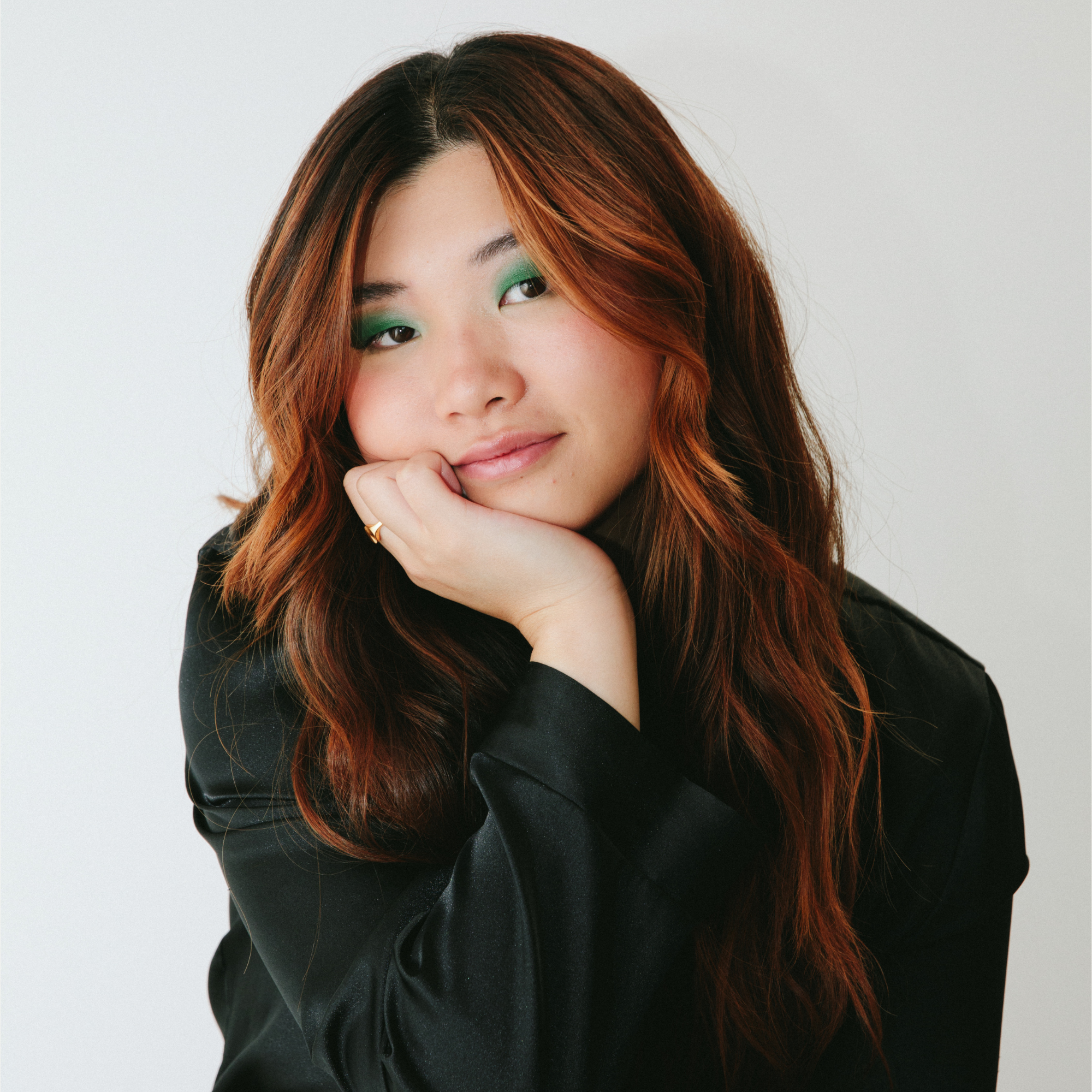
Sara Jin Li is an award-winning (and losing) multidisciplinary artist based in New York City. Her work spans stage, screen, and print, and has been featured in New York Magazine, Elle, Vogue, NPR, Cosmopolitan, and other leading outlets—always grounded in liberation for all. In a past life, she was a teen activist whose organization, Project Consent, won a Webby Award for Best Video Campaign and developed a sex ed curriculum still used in school districts today. Presently, Sara is working on her second book while continuing to direct, produce, and perform.
I remember my childhood as a slaughterhouse that I couldn’t run far enough away from. It felt so alive then, like it could grow legs to chase me. If I close my eyes really tight, I can hear the squeak of the door hinge, then the mattress. If those walls could talk, they’d weep instead. When I tell this story, I can add some distance between me and it. I reach for metaphors because I still don’t know how to say it plainly.
The way I used to tell it, I’m a survivor, not a victim. I don’t have to say what I survived. In the version I tell myself, I pretend I’ve left all of this behind.

I don’t have to say what I survived.
I was never a child afraid of the dark; everything I feared happened in the light
I was never a child afraid of the dark; everything I feared happened in the light. I was warned that if I told anyone what was happening, no one would believe me. I was told that if someone else knew, he’d make sure I’d regret it. The first time I heard the word “rape” out loud, it was as a crude joke between two boys. I didn’t know how to reconcile how they knew the word with how I knew it. Many years later, I saw a video essay about rape culture that a vlogger uploaded. The word felt impersonal when she said it, too—like a doctor describing malaria, or some other horrible things that can happen to the body.
She said rape culture is what happens when a society enables sexual assault. She said, “America doesn’t just have a rape issue, it has a rape culture,” and it felt like she was pointing a finger at me. She never said why, and I didn’t know if she said this because she knew what one in six women in America knew. I reposted the video and it felt like admitting something out loud. Even if people didn’t know about me, they could know about it.
A few months shy of my high school graduation, I created a portrait series and asked my friends to write ‘This Is Not Consent’ on their body. Many of the girls wore short skirts and scribbled the words on their thighs. To my surprise, it took off like wildfire and within days, I was getting messages from strangers taking up the cause and posting their own pictures to their social media.
I’d love to say that when I started Project Consent as a photography project, it was purely altruistic. For as much as I talked about raising awareness, what I really wanted was safety. The public outrage at rape culture was the only protection I had then; the louder the conversation around sexual assault got around me—so long as no fingers were pointed—the less my abuser came around in real life.
I wasn’t unaffected by the emotional weight of this digital crusade. Every submission came with a story. I didn’t imagine that so many people would open up the way they did. It took me so many years to say that I had been sexually assaulted. Back then, I could only talk around it in broad strokes. I didn’t know what I owed to the world in starting this project. I thought maybe it was enough to let my story blend in with the others, like a needle in a haystack.
I didn’t have the words back then, but I had the numbers. I’d frequently point at them to make a point:
- Every nine minutes, a child in the United States is sexually assaulted.
- 34% of sexual assaults reported to law enforcement will be under the age of twelve.
- 93% of victims under 18 will know their assailant personally.
- Only 1 in 3 people will ever report their assault to the authorities and of those cases, 98% of perpetrators will still walk free.
- 94% of women who have been sexually abused suffer post-traumatic stress disorder symptoms and 13% will attempt suicide in their life.
I was in every statistic. Any time I walked into a classroom, a grocery store, coffee shop, gas station, I’d do a tally of the people there. If there were ten of us, I’d estimate that at least three other people had also been assaulted. Up until I was 23, I hid in plain sight. I don’t regret taking my time, but I wish I hadn’t been so naive when it happened.
Telling the truth might set you free, but it won’t change what happened. In starting Project Consent, all I was doing was exposing a wound, not healing it. I just wouldn’t know that for a long, long time.
I thought maybe it was enough to let my story blend in with the others, like a needle in a haystack.
When did your life start?
When did your life start, if you had to put a pin on a timeline? When did you become a person full of contradictions and desires and curiosities? Was it the day that you were born, or the first time you did something so uniquely “you” that it became an anecdote to describe you? Was it even true, or just exaggerated for effect? When, exactly, did you become a real human being?
I would love to say that my life began when I first picked up a pen. Or clapped my hands at the ocean. Or saw a film for the first time. But when I think about the moments that defined me, for better or for worse, I know that it starts here: with my assault, and the years it lasted, and the years that followed. It’s not that everything prior to it didn’t matter; it’s that the sheer enormity of it eclipsed the rest. Sexual violence breaks your life into halves. I don’t remember much about the “before” other than it existed.
Look at my work. Look at what you know about me. Look at this essay, which you wouldn’t be reading if the assault had not happened. When my obituary is written, maybe someone will mention Project Consent in a line. Even in death, I’m afraid that my sexual abuse will follow me. I’m afraid my whole life will be about enduring this and calling it a triumph—not a tragedy.
Sexual violence breaks your life into halves.
#MeToo became a mainstream movement
Running Project Consent, especially that first year, was a crash course in “biting off more than you can chew.” Seen from the outside, there was this beautiful illusion that change was happening. Sexual assault advocacy was trending in 2015. Emma Sulkowicz of Columbia University turned her experience of rape and injustice into performance art. #MeToo became a mainstream movement. For a brief sliver in time, it felt like the culture was turning in favor of the survivors.
When I started college that year, Project Consent was on everyone’s lips. Beyond just our initial photography campaign, nearly everything we did went viral: think pieces on pop culture, illustrations printed on posters and clothing, callout posts shared by celebrities. In its early days, Project Consent was synonymous with liberal teen activism. We were everywhere, and relentless in our mission of raising awareness of the insidious ways rape culture is embedded in our society.
We had a dozen or so volunteers from all over the world, almost all teenagers, who wanted to champion our mission. I think our team quickly realized that even though I was the public face of the group, I was in no headspace to be running an actual organization. But everyone was incentivized to keep going by the hope that what we were doing could be enough to change the tide. We were too young to ask ourselves what happens after awareness. If enough people were aware of this epidemic of sexual assault, where was the action? We didn’t realize that this has been a fight since the dawn of time—and we were just the latest voice to chime in.
For a brief sliver of time, it felt like the culture was turning in favor of the survivors.
A Jekyll and Hyde life
In 2016, I was living a strange sort of Jekyll and Hyde life. Project Consent was still active and growing. I was travelling to different universities and speaking to their students about sexual assault and advocacy. I was presenting our work at conferences about digital campaigning and social impact to real working adults. I met with celebrities and creators and worked with their teams on content around rape culture.
From the outside looking in, I’m sure this was all very impressive. I wanted so desperately to be recognized as someone accomplished and busy. In the mid-2010s, being a strong woman was everything. I was adamant that I wasn’t a victim, but a survivor. Corporate feminism told us that if you weren’t a #Girlboss, you were weak. It’s funny, looking back, how all that pink just clouded our better judgment.
In private, I was spiraling out of control. I had behavioral issues that no one knew how to reconcile with the public image I was curating. I skipped classes and didn’t stop even when I was put on academic probation. I made impulsive, dangerous choices that didn’t just hurt me, but the people around me too. I shoplifted and couldn’t figure out why, even after I was arrested for grand larceny. I drank Monday through Sunday. I abused Adderall and benzodiazepines, playing it off as a typical college experience.
I was pretending that I was living my best life, while thinking nonstop about wanting to die. I didn’t even know I was lying.
I wasn’t interested in examining or stopping all my self-mutilation. I told myself I was just stressed, and that anyone would crack a little from all the obligations I faced. What mattered was maintaining this front and making sure the mission stayed at the top of people’s minds.
Project Consent was built from personal trauma. If I didn’t have something to show for it, then what, exactly, did I go through it all for?
Corporate feminism told us that if you weren’t a #Girlboss, you were weak.
Empowerment—the north star of all of my work—had become imprisonment
A week after Project Consent won its Webby Award, I was admitted to inpatient care after an attempted suicide. I told my friends that I was voluntarily being treated for exhaustion. Even in the midst of a mental health crisis, I felt I had to control the narrative so I wouldn’t be seen as powerless.
In treatment, I insisted that I’d made an impulsive mistake and that I was just overwhelmed with schoolwork. They diagnosed me with major depressive disorder and complex post-traumatic stress disorder and sent me home four days later. It was at this mental health facility in Olathe, Kansas that I fully grasped how easy it is to lie to people, even doctors. If you can rationalize your decision, you can convince just about anyone that you’re going to be just fine. Including yourself.
No one would know about what happened that week until a decade later. To admit the truth to other people felt like a betrayal of the public persona I had built. To admit it to myself required a level of vulnerability that I wasn’t ready for. Empowerment—the north star of all of my work—had become imprisonment. The more I wanted to impress upon everyone that I was a survivor, the less it actually felt like I had survived at all.
Meanwhile, the more acclaim Project Consent got, the less feasible it was to take a break. When Donald Trump was elected president for the first time, our work felt more necessary than ever. I thought about quitting my own organization then, more than I ever have since, because of what his win represented. If a man with numerous sexual assault allegations and confirmed ties with convicted sexual predators could be voted into office, what did it say about us, the constituents? It was as the vlogger said: America doesn’t have a rape problem; it has a rape culture.
It wasn’t until three years after the inception of Project Consent that I realized that sexual violence is not an accident in this country. It’s purposefully embedded into our DNA. The United States government is a boys’ club that benefits from—and delights in—sexual abuse. Our judicial system isn’t defunct; it’s working exactly as intended to silence the harmed party.
Every single person I knew in the advocacy space was burnt out. I had just switched to online schooling to finish my degree when Brett Kavanaugh was appointed to the Supreme Court despite allegations of sexual assault and misconduct. Whatever progress we thought we’d made toward in justice for survivors felt like a fever dream that ended abruptly. The political landscape mirrored my own growing despair—the cause I had put my name, face and life on needed more than I could give it.
I didn’t attend the first Women’s March in 2017, but I watched the footage. Thousands upon thousands of women walking through the streets, wearing anger and grief on their sleeves. I saw as many tears as I did shoes and hats that day.
Despite Project Consent, my abuser never answered for what he had done. To this day, I’m still afraid of what could happen if I named him and what actions he’d take in revenge. I knew what he was capable of when unprovoked; I didn’t have to imagine what he might do with a reason to retaliate.
To be a woman in America, where rape culture is the dominant culture, felt Sisyphean. Here is this hill that will never stop being steep and here is our ordeal, pushed against over and over again.
The political landscape mirrored my own growing despair—the cause I had put my name, face and life on needed more than I could give it.
If I had never been assaulted
I often dream about what my life would have been if I had never been assaulted. Almost every psychological feature of mine—the maladaptive behavior, inherent distrust of people, poor attachment style and self-harm—can be directly traced back to my sexual trauma. It’s all so textbook; there is very little mystery to it. I’m embarrassed by the conditions of my life and who I am. It feels like I’ve spent most of my life recovering rather than actually living it.
Another story I return to, over and over again, is the myth of Persephone. In the oldest versions, Persephone was a young maiden in her mother’s garden when she was taken by Hades, God of the Underworld—abducted, and in some tellings, raped. He brings her to his domain, and only at the pleading of her goddess mother is Persephone permitted to return aboveground for part of the year, bringing spring with her and winter when she returned to the underworld.
In many modern retellings, Persephone’s story is nothing like the older versions. In almost all the newer adaptations, her abuse is transformed into a love story where she makes the choice to go with Hades. It becomes an allegory about young girls, their sexual desire and the eroticism of the powerful and forbidden. Hades is reduced to a creature of want and urges; if he’s “uncontrollable,” it’s portrayed as romantic, not dangerous. In some contemporary translations, the sexual violence is removed entirely. A popular author who penned such a retelling of Persephone’s story said that she wanted her to be “feminist.” As if you cannot be a feminist and a rape victim. But hasn’t that been the story we’ve been telling anyway?
I’ve thought about the way people interpret Persephone’s story more than I care for the myth itself. What does it say that even in progressive circles, the idea of a woman who has been raped isn’t compatible with what we associate with strength?
I visit the life I might have had—without the sexual trauma—in the theatre of my mind, where no one can see but me. But it is not the life I’m ever going to live, so it isn’t one worth saying out loud. I’ll never know, and neither will you. My only life, burdened or not, is the one I have right now. Poor Persephone: stripped of her agency once, then robbed of her own myth a second time.
The injustice of sexual assault never ends. Not in fiction. Not in real life.
What does it say that even in progressive circles, the idea of a woman who has been raped isn’t compatible with what we associate with strength?
For the first time in five years, I could go a full week without talking about rape
Project Consent crawled to a stop, then stalled to a final death in 2017. Donald Trump was still president and the funding and opportunities that came with sexual assault prevention programs dried up. It didn’t stop the work from being done, but it pulled the wheels off of this particular cart.
I was living in New York City, and many of our original volunteers were graduating or entering the work force for the first time. Our last campaign—the creation of a sex ed curriculum that included consent—felt like our last one, even if no one said so at the time. One volunteer was starting law school in the fall; another had gotten a full-time job at a nonprofit distributing rape kits. The work continued for everyone separate from Project Consent, except for me.
After Project Consent closed, I moved to Los Angeles to pursue other opportunities. For the first time in five years, I could go a full week without talking about rape—mine or anyone else’s.
Instead, I wrote. I directed. I went back to school. I often feel guilty at the opportunities I was given through my work with Project Consent, even if they had nothing to do with sexual assault. But whenever anyone reminded me that I had an impressive brand (a body of work) for someone my age, I’d wonder if I had exploited my sexual assault for professional gain. Do other people who build some semblance of success on the backbone of their trauma feel this way, too?
Do other people feel indebted to their assault?
When Project Consent finally shuttered, it felt like a long time coming, like a graduation. The world was still brutal, but we knew through word of mouth that dozens of Project Consents (some better organized, some better funded) existed in the world. Had we continued, we would have been welcomed, but we weren’t needed. That public chapter of my life had closed, and in its wake I had to ask myself for the first time: What now?
Do other people who build some semblance of success on the backbone of their trauma feel this way, too?
You don’t have to make something of your pain
No one remembers Project Consent now, at least not by name.
Last year, I got coffee with a founder of a consent-based organization in Australia. They were growing exponentially, backed by major organizations and city governments. The determination and grit were familiar, but so was the exhaustion. I asked her about her long-term plans, not the organization’s, but hers. She looked surprised, then less so when she remembered that I had been where she was at that very moment. She asked how I practice self-care. I told her I’m still working on it.
We talked about sustainability in this space and how there is only a small window of time before you burn out. But the work was never designed to be carried out by one person. I was never going to revolutionize the world or rid it of sexual violence. We raised awareness, sure. Now it falls on the shoulders of other people to do something with that awareness.
A few months after Project Consent ended, someone in the Senate introduced a bill to help survivors tell their stories without retribution. A couple years later, someone used that bill as the grounds to end the backlog of rape kits. The momentum continued, in ways that we could identify at the time, and in other ways we won’t recognize until it’s already in the rearview.
I’ll never have a clear view on the actual impact Project Consent made. Most days, I think it’s marginal. Then occasionally, I’ll get a message from someone telling me that an infographic we made was how they explained their rape to their parents. I still advocate, just more indirectly now. I volunteer for an organization in Brooklyn that offers companions to those who want to report their assault to the police or get a rape kit done. Ironically, no one there knows anything about Project Consent. This time, it’s not about me. I don’t know what else there is left to prove anymore.
Oftentimes, I wonder what it would have been like to let myself tell the story for what it was, not how I wanted it to be received. By the end of Project Consent, I wanted to turn back and say—both to myself and others—you don’t have to make something of your pain. Whatever you do with it, if you do anything with it at all, it doesn’t change what happened to you or what you’re worth.
Sexual violence doesn’t have to mean something. Sometimes, the cards we’re dealt are just bad and the lemons are just lemons. There’s no merit in mythologizing our pain. After a decade of trying to make sense of it, I was faced with the task of just feeling it.
This time, it’s not about me.
I only kept going because the time passed anyway
People tell me I’m resilient. They mean it as a genuine, heartfelt compliment and I feel terrible resenting it, nonetheless. They said “resilient” like I rose above the violence and navigated the aftermath with willpower and grace. But I wasn’t and I didn’t. I was a child. The first time it happened, I still had some of my baby teeth. What doesn’t kill you doesn’t make you stronger; sometimes it just makes you wish it had. I only kept going because the time passed anyway.
I didn’t ask to be resilient. I would trade every accomplishment in my life if it meant not knowing how human beings can live through abysmal circumstances at great cost. People tell me I’ve gone through a lot, and all I can think is: But I didn’t ask to do that.
Millions of women in America have been sexually assaulted. Every time I thought about my own history, I just knew someone else had it worse, which made it even more embarrassing to share. It would take me years and years to begin internalizing that even if my story isn’t special, it’s still mine.
I had this big, beautiful dream of getting old and being free of those injuries. I used to think if I didn’t acknowledge it, it wouldn’t follow me. But I grew up and it grew with me. After a decade of trying to run away from it, hiding from it, disguising it, even burying it with drugs and distractions, it’s still here. A doctor recently told me my life might be very hard, but it can still be beautiful, too. I just have to be honest with myself about where I am and what I need.
Looking at life without metaphor is almost unbearable. Everyday, I have to practice a little bit of bravery by telling the truth about what happened: It was really painful. I was so scared. I’m still scared. It still hurts sometimes. It hurts right now.
I used to think that strong people, the real survivors, were those who could just get over what had happened to them. I used to speak in absolutes. I used to tell a version of this with a clear beginning, middle and ending. But a story told one way can so easily be told by another. Without metaphors, I’m learning how to build a life not around my trauma, but in spite of it. I believe it will be beautiful, even if it’s hard.
It still hurts sometimes.