







Access to family planning after an abortion is a vital part of comprehensive reproductive health care. Clinical studies have shown that fertility can rapidly return following an abortion. But access to such care has not been widely available to women in Pakistan.
In a move that promises to greatly improve access to both postpartum and postabortion family planning services, the provincial Government of Sindh has issued new standards and guidelines developed in consultation with Ipas Pakistan and a diverse group of more than 40 stakeholders.
“Ipas Pakistan welcomes this move by the provincial government to strengthen its ongoing efforts for women in both urban and remote rural areas of Sindh to make informed choices about family planning decisions,” says Ipas Pakistan director Ayesha Salma. “This will help to break the cycle of repeated unintended pregnancies and unsafe abortions.”
Sindh is home to some 47.9 million people, or about 20% of the country’s population. This document will guide service offerings and care decisions of health centers and individual providers in those areas.
In addition to providing guidance on family planning information, counseling and service delivery, the guidelines also cover training for health providers and ways to invest in sustainable supply chains for postabortion care.
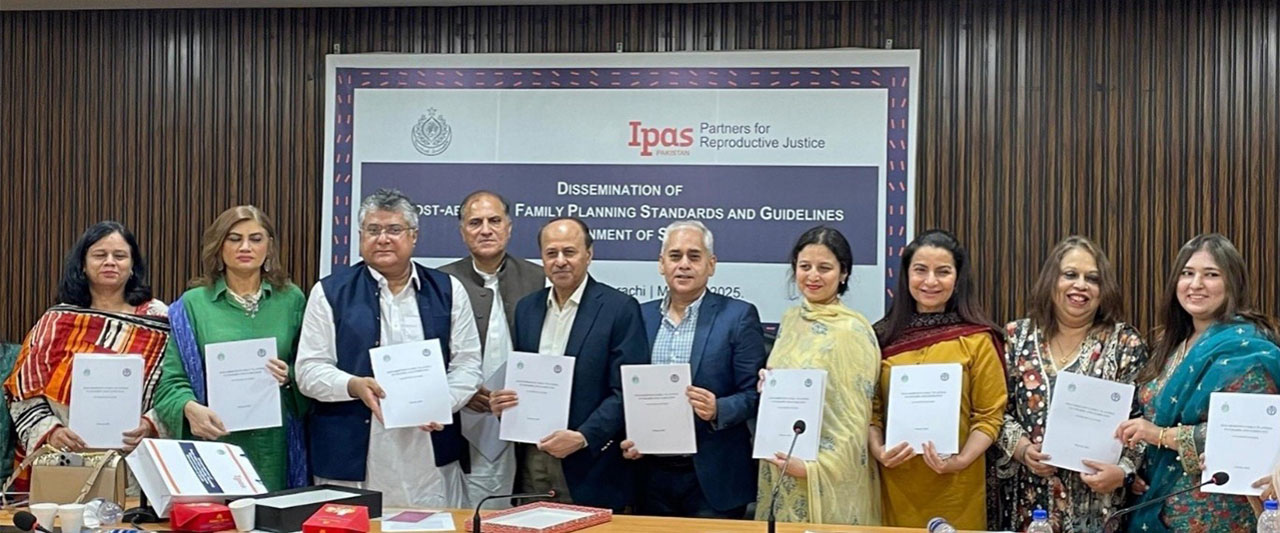
Government and community partners, including Ipas Pakistan director Ayesha Salma (4th from right), at the launch event for the new standards and guidelines.
Improving family planning care and health provider training
The standards and guidelines were drafted by Ipas Pakistan as part of its technical assistance to the provincial government and subsequently approved by both the Population Welfare Department and Department of Health of Sindh province. Ipas Pakistan coordinated a highly consultative process with public health experts, clinicians and nongovernmental organizations.
“The standards and guidelines will strengthen the capacity of health systems to deliver safe reproductive health care for countless women and girls,” says Salma, adding that the guidelines are particularly important because postabortion family planning services traditionally have not been as widely available compared to postpartum family planning.
The guidelines were launched in May 2025 at an event where the chief guest was Hafeezullah Abbasi, Secretary of the Population Welfare Department of Sindh, who said the guidelines are pivotal to standardizing care and ensuring that women have access to high-quality postabortion family planning services. The ceremony was chaired by Dr. Talib Lashari and moderated by Dr. Yasmeen Qazi, CEO of QZ Catalyst and member of the steering committee of the Pakistan Alliance for Post Abortion Care. Key speakers included Dr. Nighat Shah (Head of Department of Gynaecology and Obstetrics, JPMC) and Dr. Farhana Memon, Director General, RMNCH Sindh. Also in attendance were several other clinicians, development partners and government officials.