







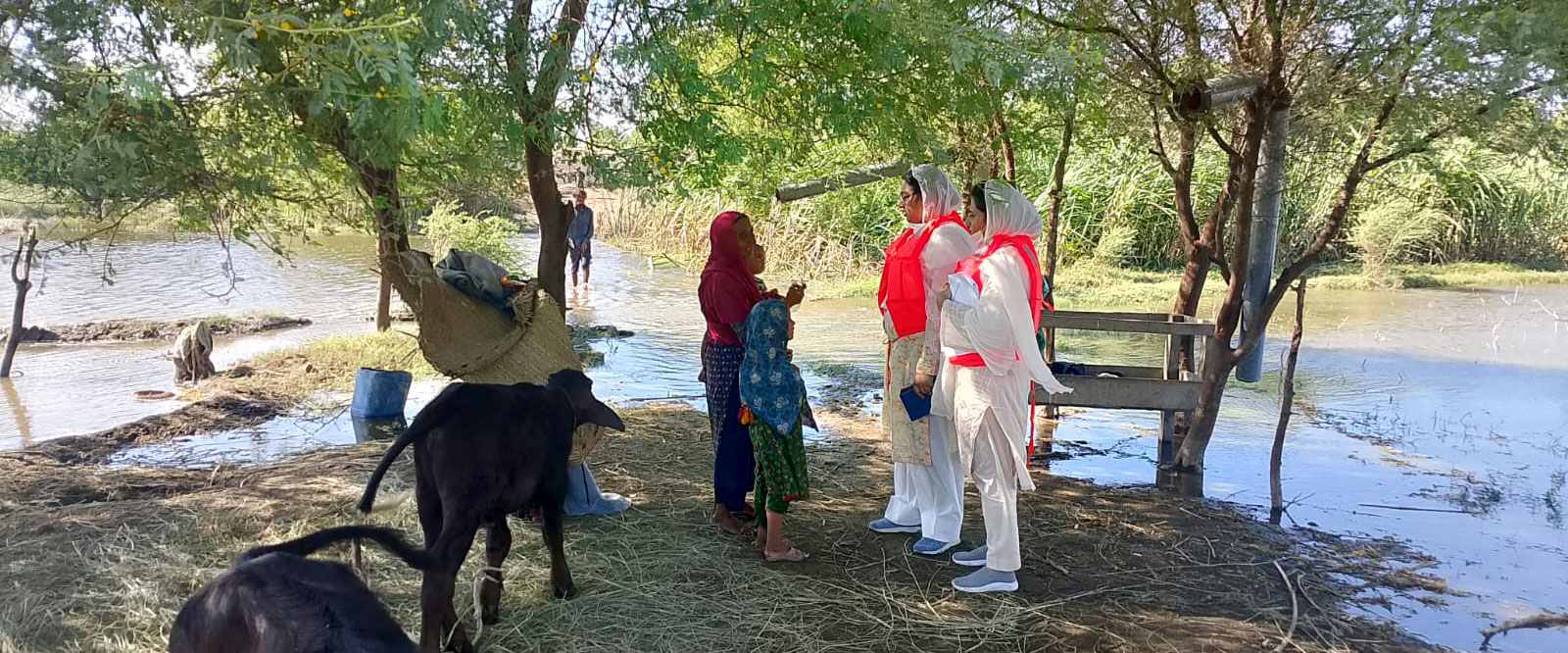
This story reflects my firsthand observations during a monitoring visit to a flood-affected community. I spent a day in the community, conducting a focus group discussion with women on their reproductive health needs before and during disasters. This is how I learnt the story of Sehrish* and her heartbreaking pregnancy and miscarriage experience. I went to meet her and later discussed the matter with the camp doctor who I requested to visit Sehrish at her home before the camp closed in the community.

Unprecedented flooding during the 2025 monsoon season in Pakistan led to more than 1,000 deaths, thousands injured, and nearly seven million people impacted since June. Around three million people have been displaced by flood waters so far.
In climate-induced crises like these, women and girls are disproportionately impacted. Many face unmet reproductive health needs, including unmanaged complications of pregnancy loss, disruption of antenatal services, and reduced access to contraception services. While multi-sector response efforts often meet basic needs like food, shelter and water, very little attention or resources are allotted to providing lifesaving reproductive health services such as postabortion care and family planning.
That is why Ipas Pakistan—in collaboration with its local partner Rahnuma-Family Planning Association of Pakistan (Rahnuma-FPAP)—initiated a humanitarian response to address these critical reproductive health-care needs, as well as primary health-care needs, of people affected by the floods. Our goal was to conduct 150 medical camps and 150 community sessions, reaching approximately 9,000 people in need—with a strong focus on women and girls of reproductive age.
Sehrish’s* heartbreaking story
*Name changed to protect her identity.
A team from Rhanuma-FPAP set up a mobile medical camp to provide reproductive health services in a small, flood-affected village, just three days after a heartbreaking tragedy. During a monitoring visit, we learned about Sehrish*, a young woman who had lost her baby only days earlier.
When we reached her home, we found her lying weak in bed. The outer wall of her house had collapsed due to the floods, and the family was forced to operate from only one room. All her belongings were wet, and the space had a strong smell, but she had no alternative place to stay. She was feverish, pale, and carrying the heavy weight of exhaustion and grief.
Sehrish explained that her family had recently returned from a relief camp after the flood water had finally receded from their home, though the village around them was still waterlogged and damaged.
“When we came back from the camp, nothing was the same,” Sehrish said softly. “The house was wet, everything stunk, and we had to start cleaning immediately.”
She is anemic and had gone into premature labor after seven months of pregnancy. With no transport and no one available to help, her family called the local dai (traditional birth attendant). In the quiet darkness of the night, she delivered a premature baby who struggled to breathe—and within two hours, the child was gone.
Her voice trembled as she recalled the night she lost her pregnancy.
“I felt everything collapse. I was already stressed from the camp and from cleaning the house all day. I didn’t rest at all. Then the pain started, and my mother-in-law called the dai. My baby lived for only two hours,” she said, clutching the corner of her dupatta (shawl).
In 2024, after ten years of marriage, she gave birth to her first child. This was her second pregnancy in less than a year. Her first child is only nine months old. With no rest, no support, and overwhelming responsibilities, her health had deteriorated.
A camp doctor from Rahnuma–FPAP, which had organized a mobile health camp funded by Ipas in her community, visited her home, examined her, and confirmed that she was suffering from anemia and a fever caused by an infection. The doctor explained that the infection was serious and required proper treatment, which included antibiotics. She advised the woman to rest, improve her nutrition and hygiene, take the prescribed medicines on time, and avoid becoming pregnant again too soon. The doctor also provided counselling on family planning options that she could consider when her fever subsided.
“Your body needs time to heal,” the doctor told her gently. “You matter too—not just your baby.”
When asked why she hadn’t gone to the nearby rural health center, Sehrish lowered her eyes.
“Who would look after my baby?” There’s no transport. And after the flood, we barely manage to eat,” she whispered. “We are landless tenants, and the water destroyed our crops. There is no work left for anyone.”
Her delivery took place at midnight. Unable to afford transportation or hospital care, the family relied on the dai who had also delivered her first child at home.
A harsh reality faced by countless women in Pakistan
Unfortunately, Sehrish’s story is not an isolated one. It reflects the harsh reality faced by countless women in rural and disaster-affected communities—where early pregnancies, poor health, poverty, limited access to services, and the burden of climate-induced crises combine to endanger their health and deepen their suffering.
Our medical camps provide access to lifesaving essential reproductive health care with a specialized focus on providing lifesaving reproductive health services, including family planning, contraception, postabortion care and maternal and child health services. Community sessions engage men, women, young people and individuals with disabilities to educate them on reproductive health, maternal and child health, maintaining good hygiene and limiting the spread of infectious diseases, as well as how to access health services when needed.
We are also supporting people in flood-affected areas by distributing clean delivery kits for pregnant women, dignity and health hygiene kits.
Our focus during the recovery phase, as well as in the preparedness program for climate-induced emergencies with the government and civil society organizations, is on strengthening the health system—including capacity building, facility upgrades, and advocacy with authorities to prioritize the Minimum Initial Service Package in contingency planning, and to ensure the availability and continuity of postabortion care and family planning services during emergencies. We are also committed to building the resilience of vulnerable districts to ensure safer conditions for women and girls during any disaster they may face.