




Twenty years ago, Ethiopia liberalized its abortion law in a landmark decision that has saved lives and expanded rights across the country. Since then, far fewer women have suffered death or injury from unsafe abortion, and more people have had the power to decide their own futures.
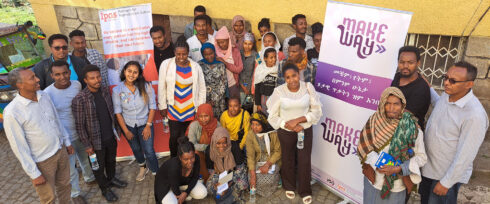
But the story of the abortion law change in Ethiopia is incomplete without mentioning the incredible resilience of advocates, health workers, policymakers and Ipas staff and partners who made it happen. They’re still working today, now focused on training health providers, educating communities about where to access safe care, and protecting gains made from anti-rights actors.
This is what resilience looks like. People from across society coming together to make change—and then to continue moving forward, because the fight for abortion access for all doesn’t end with making abortion legal. There is always more work to do.
In this Q&A, Ipas Ethiopia’s country director, Dr. Demeke Desta, reflects on the journey so far, the wins, and why there’s always more work to be done.
Photography and videography by Abinet Teshome
Question: Before joining Ipas over 15 years ago, you worked as a medical doctor and program lead in Ethiopia and across Africa—so what was the situation like 20 years ago, before the abortion law changed?
Dr. Desta: Ethiopia had one of the most restrictive abortion laws in the world, and maternal mortality was very high. There was no access to safe abortion services, no technology, and no trained health workers to provide care. Almost all women attempted abortions through unsafe means or with the help of unqualified individuals, resulting in severe complications.
Women would come to health facilities with bleeding, infection, organ damage, uterine perforation, and other life-threatening issues—especially during off-hours. We had to act quickly, providing blood transfusions and emergency procedures, but we still lost many women.
Every hospital had a ward known as the septic ward, where women with complications from unsafe abortions were treated. These wards were overcrowded and foul-smelling. Even when we saved women, many suffered permanent damage: hysterectomies, chronic reproductive issues, pain during intercourse, and infertility. It was devastating.
Medical schools didn’t teach us how to provide safe abortion care. We didn’t have the knowledge, skills, or equipment. We were only treating the consequences. At that time, abortion complications were the leading cause of maternal death—nearly one-third of maternal deaths were due to unsafe abortion.
And those were just the women who made it to the hospital. Many more died in the community. It was a terrible time for women, health workers, and communities alike.
“
Medical schools didn’t teach us how to provide safe abortion care. We didn’t have the knowledge, skills, or equipment. We were only treating the consequences.
What was your role in the revision of the abortion law?
I can’t claim full credit—many people played major roles in the revision—but I contributed where I could. At the time, I conducted a literature review on the benefits of safe abortion.
The process itself was very transparent and open. When a new government came to power, the constitution was revised. To align other laws with the new constitution, the penal code was also reviewed.
Medical professionals, legal experts, women’s rights groups like the Ethiopian Women’s Welfare Association, and professional associations such as the Ethiopian Society of Obstetricians and Gynecologists came together to advocate for change. They compiled research, synthesized data, gathered public opinion, and even arranged study visits for decisionmakers to learn from other countries with more progressive abortion policies.
Ipas was part of this coalition, though I wasn’t with Ipas at the time. I was working with another organization but remained active in the discussions. I concluded from my review that safe abortion access offers far more benefits than restrictions. But the real credit goes to the senior leaders and advocates who led the charge to revise the law.
What impact did the legal reform have on women’s health?
The change was transformative. Before the reform, unsafe abortion accounted for one-third of all maternal deaths. The maternal mortality ratio was over 800 per 100,000 live births—among the highest in the Africa region.
After the law was revised and implemented, complications from unsafe abortions dropped dramatically. Maternal deaths due to unsafe abortion decreased from 32% to less than 5%.
Because of the legal reform and service expansion, safe abortion became available, and the old post-abortion wards—the septic ward rooms—disappeared.
The lives of countless women were saved, but we haven’t completely eradicated unsafe abortions. Some women still lack access, so there’s more work to do.
“After the law was revised and implemented, complications from unsafe abortions dropped dramatically. Maternal deaths due to unsafe abortion decreased from 32% to less than 5%.”
What message do you have for advocates in other countries?
My message is to be persistent, resilient, and strategic. Every country has its own priorities. If human rights don’t resonate with policymakers, frame the issue as a public health concern.
Advocates should generate evidence tailored to their context and push based on their country’s priorities. Learn from other countries—Ethiopia, for example, had a very transparent and structured law reform process. The benefits of our reform are clear.
Advocates should gather relevant evidence and continue pushing for women’s health and rights.
“
My message is to be persistent, resilient, and strategic. Every country has its own priorities. If human rights don’t resonate with policymakers, frame the issue as a public health concern.
See how Ipas Ethiopia’s resilience continues today